Michelle Yi Martin’s 'The Shape of Dusk'
On view at Jessica Silverman

‘The Fates’ in ancient myth, whose primary tools are the making of cloth and yarn, are responsible for lives of the mortal realm. Clotho (Klōthō), ‘the spinner,’ is credited with the present, and from her spindle emerges the raw material for life, ever-becoming organized and assembled by her sisters. So significant is the making of fabric that the ancients bestowed upon weaving all of the living human world. What is interesting about this myth is that life is always becoming. Never a finished textile, these sisters are constantly spinning, measuring, and weaving cloth–the process itself being the life-making substrate. There are traces of this in works by artist Michelle Yi Martin.
Yi Martin’s fabric sculptures are made on a floor loom incorporating materials such as jute, metallic threads, horsehair, nylon, paper, and silk. They are woven into assemblage by the artist’s kinetic intuition. Off the loom the fabric’s tensions release. They are coiled, wrapped, suspended, and brought off the wall to form cocooned pillars that meet me like a room of figures. They appear like skeletal coverlings or like metaphysical mummifications.
I think the complexity–unnerving to the present–of all craft is its Chronos. Fabrics protect us, bring us closer to the Earth. They remember us as gods and as nomads and as homesteaders–as ancients and as pioneers, as lovers, as bearers of life, as mothers, as gleaners, as mourners, and as spirits drifting on to other realms. I am reminded of this in works Shadowgraph (2026) and Radiograph (2019). Both suggest they are parts of a greater living whole, trailing off to the ceiling or unraveling, ellipse-like, towards the floor. All around us, throughout all of material history, cloth is there connecting us to and from ourselves.
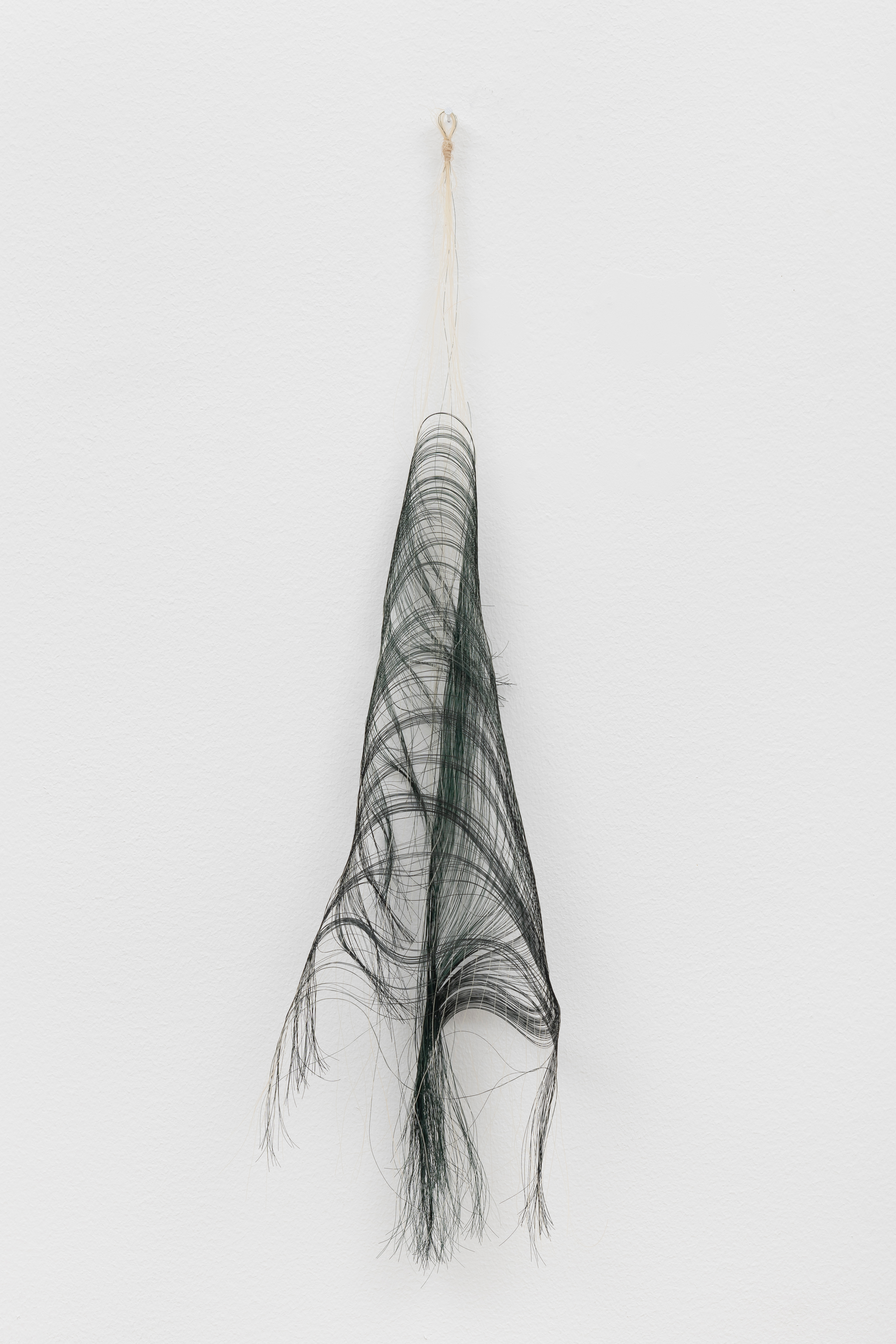
Radiograph, 2019, Horsehair and monofilament, 25 × 7 x 3
In On Weaving, Anni Albers writes that we might imagine the modernization of fiber and cloth as a means of reading history. Instead of the “Stone Age,” what about a “Flax Age”? For me, the urgency of Yi Martin’s works, after Albers’ reconsideration of history, is in their response to how our region is in the process of prophesying a new historic period we have yet to understand. All around us today people murmur of total social and structural overhaul through advancements in large-language computing models. Quick to declare that we’re headed uncontrollably towards human disaster, technological oligarchs and private companies attempt to play their hands at The Fates, rushing to pool resources into ever-smaller locales.
Clotho may still call the shots. As her myth goes, if we risk wearing away threads still emerging from her spindle, or through the heddles of her loom, we risk unraveling the entire universe. To declare doom and the end of life is to forgo metamorphosis and will it to be. Michelle Yi Martin’s works stand affront to these compulsions, and imagine transformation and becoming in a way that reminds me of how lovely the unknown future can be. What if, as the textile suggests, we collectively slowed, emerged, and made peace with present unknowables by holding the values of living at our cores?
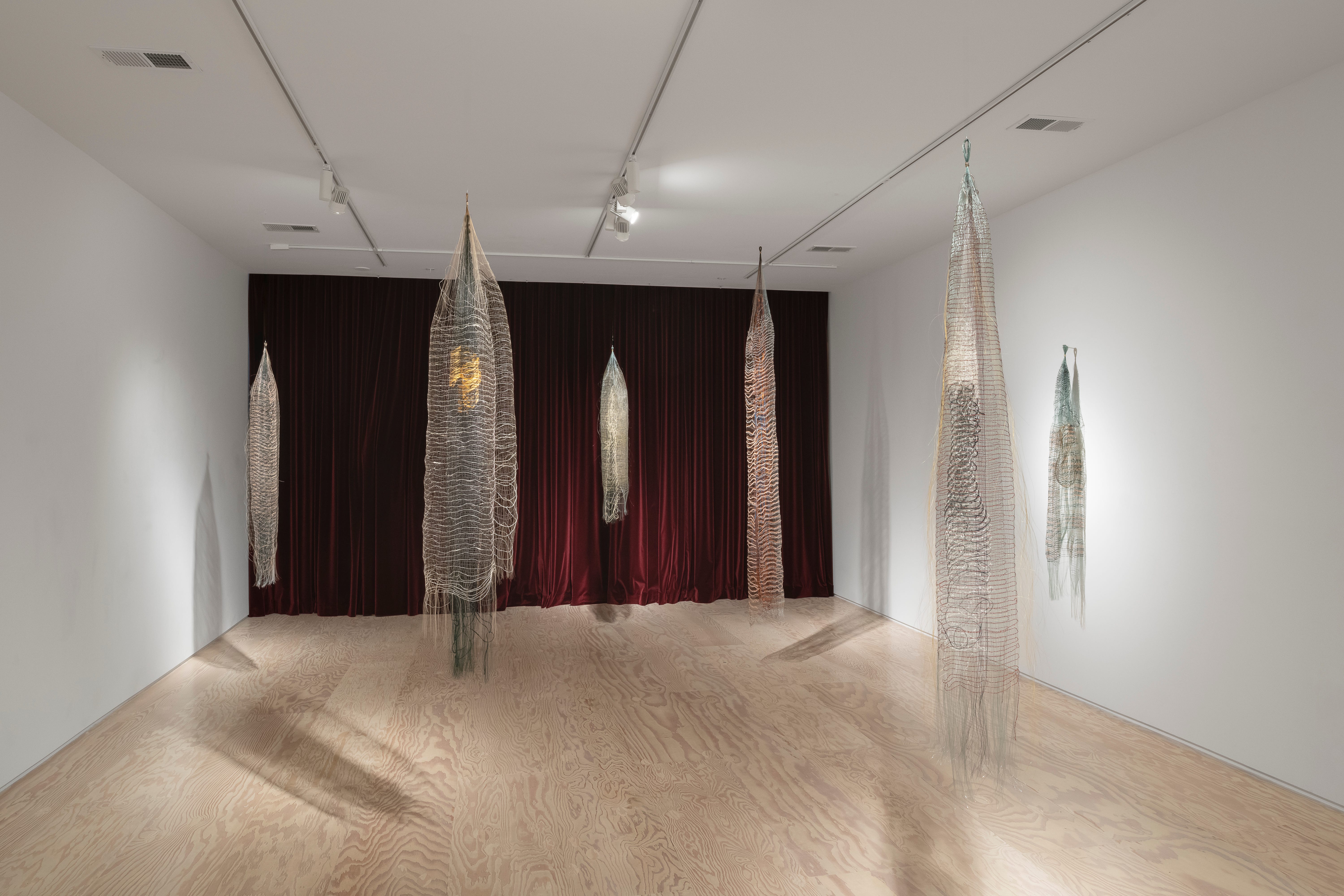
Installation view. Michelle Yi Martin, The Shape of Dusk is on view in San Francisco through April 18.
