Estranged From The Sun
Text for Natalya Kornblum Laudi and the Re Institute, New York

The Re Institute and Natalya Kornblum Laudi present Estranged From The Sun, a group exhibition focused on examining the relationship between the land in and beyond upstate New York, and its contemporary labor landscape; its tools, its people, its poetics, and the way it lives within the post-modern western imaginary. The exhibition features work by Micah Angelus, Jasem Alsanea, Felix Beaudry, Cecilia Caldiera, Linea Gad, Ingemar HK, Clare Koury, Natalya K Laudi, Arel Lisette, Cal Seigel, Emily Small, Lou Smith, Malaika Temba, and Alejandro Valencia. It will open April 11th, and remain on view through May 16th, 2026.
In a note tucked into the digital folds of my phone I’ve kept the verbatim parcel with the cursor flashing: “Rousseau–cultivated; Hobbes–conquered; Locke–land is created by god for use and resources for humanity: the visual conceived as an empty place then deems resources to be commodified and not to be ‘wasted’.” In his 2009 publication Against the Anthropocene, historian TJ Demos proposes that the term Anthropocene extends past describing a geological epoch, and toward the ideological neoliberal financialization of nature. This is a pattern long on repeat since the symbolic formation of land as empty by Western philosophy led us to the expansion of European conquest that would become the colonies and the Americas as we know them today. When we look at the rural now–at farmland, old factory buildings sprawled across our rust-belt cities, or abandoned and reclaimed mill-towns of the North East–what pains the heart, and what do we see? Before the mid-nineteenth century, much of the United State’s population was settled upon farmland or in rural areas, largely operating by the rhythms of the tasks needed by the land, guided by the sun’s rotation and the season’s shifts. Industrialization greatly altered this population by promising steady wages in fledgling urban spaces. Many young women would leave their lands from across the plains, to northern Europe, to work in the textile mills that appeared across the North East in the early 1800s, and time would irrevocably shift from an agrarian model to one based on factory calls.
Now, three to four generations out from the industrial revolution we approach a successive kind of epoch, where technological advancements have observants ringing the bells at the steps of the next ‘industrial’ revolution. We careen toward ecological crises as populations from the south of India to the gulf coast of the United States and Mexico face violent, unprecedented, storms. What can looking back to a historic split between the urban and the rural tell us about what our future might hold?
I am currently based in Northern California, where the second and third growth redwood forests look radically different in scale and dispersion than the original groves that covered the land before the logging industry settled in. Still when I imagine the wild in my home, it is the second growth trees that I see in my mind’s eye. In the 1970s, back-to-the land movements bore communes and alternative social and spiritual practices alongside models of how the urban might divest themselves from their city lives here. With resources such as Country Women Magazine their intentions towards self sufficiency made brilliant critiques of demographic access to nature, but often bypassed a kind of indigenous stewardship that left their projects repeating types of rural-fettishization we battle with on the political field today. Furthermore, our conception of the work within the land remains altered: when we envision a sickle as children of the parents who were young in the 1970s and 80s, it is images of the Cold War that come to mind, before the grain we may cut down with its blade. Although much of the population of the United States still live and work in and on designated rural areas, caught within a landscape of fungible time invented from factories estranged from the sun and season cycles that dictate work, fundamental shifts of capital have altered how life on the land might be in the dominant contemporary imagination.
With a syntactic examination of landscape as a configuration of politics that surround the rural labor-imaginary, one that is gendered, sexed, and makes assumptions about time, class, and resources, this exhibition’s artists consider the poetic potential that ‘land’ holds for greater society’s progression. Rather than a superlative or critique of one or the other, the rural/urban labor divide is approached as a place where artists observe how an identification with either is created, circulated, and maintained. How can artworks help us remove the temporal oppression we oppose in our governing systems, platforming the developing needs of the land and of work, for all? In, “Metaphysics of Youth” (1913-1919) Walter Benjamin writes–
As landscape all events surround us, for we, the time of things, know no time. Nothing but the leaning of the trees, the horizon, the silhouetted mountain ridges, which suddenly awake full of meaning because they have placed us in their midst. The landscape transports us into their midst, the trembling treetops assail us with questions, the valleys envelope us with midst, incomprehensible houses oppress us with their shapes. We, their midpoint, impinge on them. But from all the time when we stand there quivering, one question remains: Are we time? Arrogance tempts us to answer yes—and then the landscape would vanish.
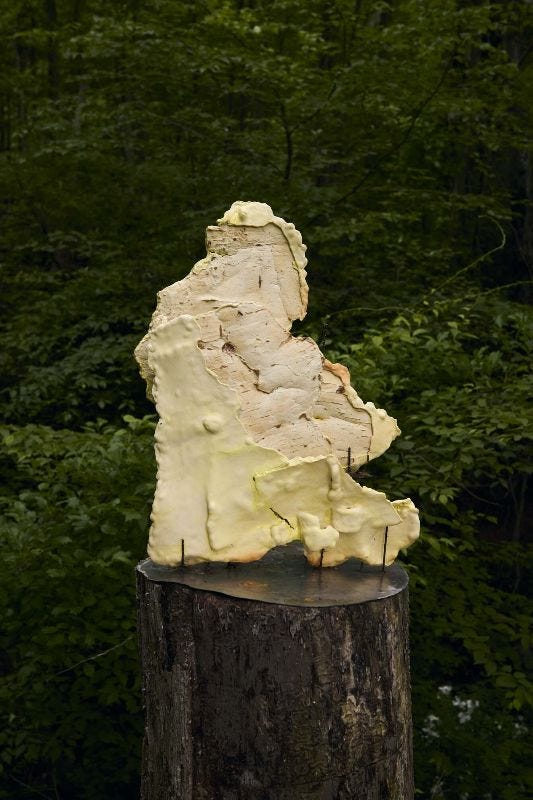
Peeling, Linnéa Gad
The Mill Girls of Lowell, National Park Services, 2025. https://www.nps.gov/lowe/learn/historyculture/the-mill-girls-of-lowell.htm#:~:text=For%20many%20young%2C%20rural%20women,was%20often%20born%20of%20necessity.